
"Niche real estate websites aren't generic sites with fewer listings. See the exact features each vertical (luxury, CRE, PM, brokerage) requires."
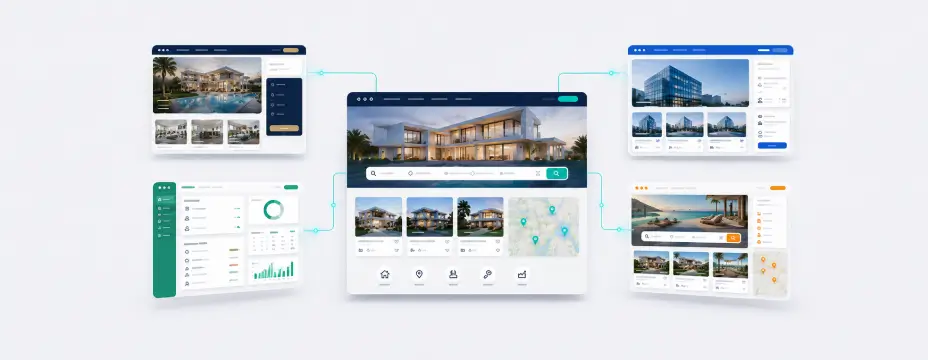

Luxury is the vertical where buyer behavior dictates web design most directly. The US luxury residential market is valued at roughly $289 billion today and projected to exceed $338 billion by 2030, per Mordor Intelligence data reported by HousingWire in November 2025.
Four structural requirements separate a luxury niche real estate website from a generic one. First, the visual production bar: at least 20 photos per listing with full-screen lightbox, Matterport 3D tours embedded on the page, and cinematic drone video in the hero.
Second, a quiet-luxury aesthetic: a restrained palette and editorial copy that tells a lifestyle story instead of reciting specs. DMR Media notes that gold, black, and white schemes read as elegance and exclusivity. Third, agent personal branding, where Christie's and Sotheby's present agents as cultural curators rather than salespeople. Fourth, design that respects how cash buyers move.
The cash-buyer pattern is the part most builders underestimate. Realtor.com data reported by HousingWire shows roughly half of sales between $2 million and $5 million, and more than 65% between $5 million and $10 million, are all-cash. In practice, these buyers tend to vet extensively online before making contact, so the media and editorial layers carry real weight.
Christie's International Real Estate is the reference model for luxury real estate website design: curated inventory with no public IDX feed, listings presented through lifestyle editorial copy, and agents positioned as art-world curators. Sotheby's International Realty runs a comparable setup. As Miami agent Ana Bozovic told HousingWire, "The higher up we go in price or price per square foot, the more all-cash our market is" (which is exactly the buyer the editorial layer is built to reassure).
The tradeoff is real: that heavy media bar means CDN delivery, real hosting headroom, and developer time most generic builds never budget for. See how to build a luxury real estate website from the ground up, or explore the best luxury real estate websites for design and feature inspiration.

Commercial real estate flips the residential playbook. CRE buyers are professional decision-makers who screen by financial metrics before they look at a photo. A site that buries the numbers behind a contact form loses institutional buyers in seconds, and that fact decides the entire data layer.
A CRE site has to expose fields a residential search engine never carries: cap rate, net operating income, price per square foot, building class (A, B, or C), occupancy rate, and lease type (triple-net, double-net, gross, modified gross). Lease listings add tenant-improvement allowance and rent escalation schedules; industrial properties add clear height, loading docks, power in amps, and rail access. None of that exists in a residential schema.
Digital adoption is accelerating. Crexi reported $815.6 billion in active sales listings through November 2025, up 16.7% year over year, in its December 2, 2025 release, and the platform now supports more than 2 million monthly active users to date. Deloitte's 2026 Commercial Real Estate Outlook, a survey of more than 850 global CRE executives, found tenant relationship management, lease drafting, and portfolio management topping respondents' AI priorities for the next 12 to 18 months.
As Michael DeGiorgio, Founder and CEO of Crexi, put it, "The pace of CRE deals today isn't just set by the market. It's also shaped by the tools people are using."
The other half is document production. Every CRE deal runs on an offering memorandum, and generic sites cannot generate one. Sam Losek of CREBuilder, a CRE marketing-software firm, argues: "The broker who gets a polished OM in front of qualified buyers on day one of exclusivity wins more deals." That is why specialized commercial real estate websites carry document tooling residential sites lack.
One honest limit: no WordPress theme natively generates an offering memorandum, so a CRE site needs purpose-built CRE software running alongside it. Browse the best commercial real estate websites for platform comparisons and feature benchmarks.

Property management is the vertical builders most often misread, because a property management website is not really a listing page. It is an operational portal. The US property management industry generated an estimated $119.1 billion in 2024 revenue across 304,000 businesses, per iPropertyManagement.com, with 84.6% of that coming from residential management.
The defining structural insight is that a PM website serves three audiences at once, and each one needs its own portal.
This is where two well-known portal architectures diverge. Buildium typically positions itself for small-to-midsize residential portfolios with a streamlined admin dashboard. AppFolio targets larger operations with AI-driven maintenance routing and role-based permissions. Neither is a WordPress real estate theme; both are dedicated platforms that sit alongside a marketing site rather than replacing it.
Keep the line clear: the WordPress site handles marketing and vacancy capture, while the PM platform handles every operation behind it, and the two are not interchangeable. For the WordPress starting point, see our property management website template built for this vertical, which covers the marketing and tenant portal layers a property management website tenant portal setup requires.

A brokerage website is not an agent website scaled up. It is architecturally different, and treating it as "more agents on one site" is how these projects go sideways. Four dimensions set it apart.
Compass shows what real estate brokerage website IDX integration looks like at scale. Each agent gets a personal sub-site that inherits the Compass brand system, and Compass Luxury (luxuryatcompass.com) runs as a curated high-end sub-brand. Compass provides each agent with proprietary CRM and marketing-automation tools integrated into the brokerage site ecosystem. That is integrated agent-in-brokerage architecture, not a directory of headshots.
Lead routing is usually handled by the IDX provider or CRM, not the theme alone. The tradeoff to weigh: native IDX pays off in compounding organic search, but it is slower to build and configure than dropping in an iFrame. Agents and teams starting from WordPress can explore the real estate broker WordPress theme built for multi-agent workflows.